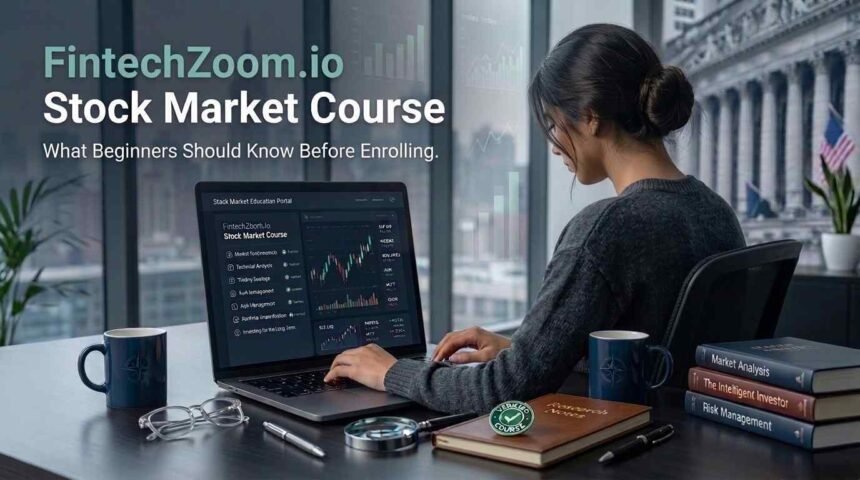
Learning the stock market can feel a little like walking into a conversation that’s already halfway through. Everyone around you seems to know what a bull market is, why interest rates matter, and whether a particular stock is worth buying. Meanwhile, you’re still trying to figure out where to begin.
- Key Takeaways
- What Is the FintechZoom.io Stock Market Course?
- What Does the FintechZoom.io Course Claim to Teach?
- FintechZoom.io vs. FintechZoom.com: What’s the Difference?
- Is the FintechZoom.io Stock Market Course Right for Beginners?
- 6 Things to Check Before Paying for Any Stock Market Course
- Can You Learn the Stock Market Without Paying for a Course?
- Frequently Asked Questions
- Final Thoughts
- Disclaimer
That’s exactly why structured online courses appeal to so many beginners. A good course promises to cut through the noise, explain how markets actually work, and help you make more informed decisions with your money.
One name that comes up in these searches is the FintechZoom.io Stock Market Course. But before you sign up, or enter your payment details, there’s a critical detail worth understanding: FintechZoom.com explicitly states that fintechzoom.io is not affiliated with its official website.
That distinction matters more than it might seem. A similar-sounding name can create an impression of familiarity and trust, especially when you’re researching something unfamiliar for the first time. This article walks through what the FintechZoom.io course claims to offer, what you can and cannot independently verify, and what every beginner should check before paying for any stock market education online.
Key Takeaways
- FintechZoom.com explicitly states that fintechzoom.io is not affiliated with its official website, despite the similar names.
- The FintechZoom.io course publishes course pages, but key details such as instructor credentials, full pricing, and a lesson-by-lesson syllabus are not easily verifiable from public content.
- No stock market course can guarantee investment profits. Any program that implies otherwise is a red flag.
- Free, reputable resources from the SEC, FINRA, NYSE, and Nasdaq can teach stock market fundamentals at no cost.
What Is the FintechZoom.io Stock Market Course?
The FintechZoom.io website includes a dedicated courses section offering programs in financial literacy, stock market trading, and stock market investing. These are positioned as structured learning paths for beginners and people with some existing financial knowledge.
On the surface, the course descriptions cover topics that are genuinely relevant to new investors. But the website does not clearly publish instructor names, verified professional credentials, a detailed lesson-by-lesson syllabus, or full pricing information in an easy-to-find format.
This matters. Many established educational providers make this information available before asking for payment. When it is missing or difficult to find, that is a reason to ask direct questions and verify claims independently before committing.
What Does the FintechZoom.io Course Claim to Teach?
The site advertises two distinct programs: one focused on trading, one on investing. These are related subjects, but they serve very different purposes, and the difference is important before you choose a course.
Trading generally means buying and selling assets based on price movements and strategy, often over shorter periods. It requires active attention, a tolerance for risk, and an understanding of market mechanics.
Investing usually focuses on building wealth over time by selecting and holding assets that align with your financial goals. It tends to emphasize patience, diversification, and fundamentals over short-term price action.
Why does this distinction matter? Imagine you want to start putting part of your monthly salary into the market to grow your savings over the next ten years. A course dominated by day-trading strategies may not be the best starting point. You would likely benefit more from understanding company fundamentals, how to build a diversified portfolio, and how to manage risk over the long term. Be clear about what you actually want to learn before choosing a program.
Stock Market Trading Course
According to the course page, the trading program covers:
- Market fundamentals and price movements
- Candlestick patterns and technical analysis
- Day trading, swing trading, and position trading strategies
- Stop-loss techniques and risk management
- Trading psychology and market indicators
- Advanced trading tools and market concepts
The page also advertises 4–6 hours of on-demand video lessons, quizzes, practical resources, and a certificate of completion.
If you are new to reading market charts, our guide on how to read a Nasdaq chart explains the basics before you explore trading strategies.
Stock Market Investing Course
The investing course describes a broader, longer-term approach to managing money in financial markets. Listed topics include:
- Risk and return fundamentals
- Stocks, bonds, ETFs, and other asset classes
- Portfolio diversification and asset allocation
- Value investing and dividend strategies
- Financial planning and long-term investment goals
- Understanding market volatility and making better investment decisions
The page advertises 7–8 hours of on-demand video lessons. For someone new to investing, this topic list provides a useful checklist when comparing different educational resources, even if you ultimately decide not to use this particular provider.
FintechZoom.io vs. FintechZoom.com: What’s the Difference?
This is the most important section of this article, so it deserves careful attention.
FintechZoom.com is an established online financial publication covering stock markets, cryptocurrency, banking, and fintech news. It publishes market data, index tracking, and editorial content, and it includes a clearly stated disclaimer that its content is for informational purposes only and does not constitute financial advice.
Critically, FintechZoom.com explicitly states that fintechzoom.io is not affiliated with its official website.
Based on publicly available information, FintechZoom.io’s course pages do not clearly identify the operating company, named instructors, or independently verifiable credentials.
This naming pattern, where a lesser-known site uses a domain that resembles a recognized brand, is common in the online finance and education space. It can create an impression of credibility or connection that simply does not exist. A polished website, a professional-looking certificate, or a name that sounds familiar is not the same thing as verified legitimacy.
What this means for you: Do not assume that the FintechZoom.io course is produced by, endorsed by, or connected to FintechZoom.com. If you have seen marketing that implies this relationship, treat it as unverified. Always confirm affiliation through the brand’s own official channels, not through lookalike domain names.
Is the FintechZoom.io Stock Market Course Right for Beginners?
The site describes its courses as suitable for beginners as well as people with some financial background. That makes the advertised subject matter potentially relevant to someone starting from scratch. But suitability depends on more than who a course says it’s designed for.
A strong beginner course should start with foundational concepts before moving to more complex ideas. It should explain things in plain language, introduce topics in a logical order, and use real examples that help you apply what you learn. For instance, a lesson on diversification should go further than defining the word. It should explain why owning shares in several companies within the same industry may still leave you exposed to similar risks.
Likewise, a lesson on risk management should explain not just how losses happen, but how they affect a portfolio over time and why no strategy can eliminate uncertainty entirely.
Because these qualities cannot be confirmed from publicly available content about the FintechZoom.io course, prospective students should ask the provider for detailed information directly and verify any claims independently before paying.

6 Things to Check Before Paying for Any Stock Market Course
These checks apply whether you are evaluating the FintechZoom.io course or any other online program.
1. Verify the Provider’s Identity
Search for the company’s legal name, business registration, and contact details. Check how long the domain has been active and whether the organization has a consistent, verifiable presence beyond its own website. Look for independent reviews on third-party platforms, not just testimonials the provider has selected to display.
For FintechZoom.io specifically: resolve the affiliation question before proceeding. Confirm whether the site is connected to FintechZoom.com or is an entirely separate operation.
2. Request a Detailed Syllabus
A legitimate course should provide a module-by-module breakdown of topics, learning objectives, and the skills you will develop, before you pay. Vague topic lists paired with bold earnings claims are a warning sign. If a provider cannot show you what a specific lesson covers, ask directly.
3. Investigate Instructor Credentials
Look for named instructors with verifiable professional backgrounds: registered financial advisors, licensed brokers, or documented experience in the subjects they teach. Financial experience can be valuable, but it should be supported by evidence rather than vague references to industry expertise. If an instructor cannot be found outside the course’s own marketing materials, that matters.
4. Understand the Full Cost
Get the complete pricing picture before signing up. This includes any upsells, subscription renewals, or premium tiers introduced after the initial purchase. A stated refund policy is a claim to verify in the written terms, not a guarantee that getting a refund will be simple or straightforward.
5. Be Skeptical of Profit Promises
No course, platform, or instructor can guarantee that you will make money trading or investing. Financial markets carry real uncertainty, and even experienced investors make incorrect decisions. Any program that suggests a proven system, a guaranteed win rate, or a reliable way to predict the market deserves serious skepticism.
6. Value Practical Learning Over Certificates
A certificate of completion tells you that you finished a course. It does not confirm that you can apply what you learned. A more useful test is whether you can actually explain what you studied: how a company generates revenue, what might affect its stock price, and how to weigh risk before making an investment decision. That kind of understanding is what protects you when real money is on the line.
Can You Learn the Stock Market Without Paying for a Course?
Yes. And for many beginners, free resources are the best place to start.
You can build a solid foundation by beginning with the basics: what shares represent, how stock exchanges work, why prices move, and how companies report their financial performance. From there, you can explore diversification, investment fees, compounding, and the relationship between risk and potential return. Once those ideas are clear, you can move on to how investors evaluate businesses and compare different strategies. Understanding major indexes can also help; our guide explains the difference between the Nasdaq Composite and Nasdaq 100.
One useful practice is to choose a publicly traded company and, before looking at its recent price history, write down three things:
- How does this company make money?
- What could strengthen or weaken its business over the next few years?
- What risks might make this investment unsuitable for a particular investor?
Then look at the company’s published financial information and see whether your initial assumptions hold up. This exercise builds a habit that is often overlooked in beginner trading content: forming a reasoned view before reacting to price movements.
Here are some free, reputable places to start:
- SEC (sec.gov): The U.S. Securities and Exchange Commission publishes accurate, beginner-friendly guides on investing, how markets work, and how to spot fraud.
- FINRA (finra.org): The Financial Industry Regulatory Authority offers investor education tools, including a free broker verification database.
- NYSE and Nasdaq: Both exchanges publish educational content explaining how stock markets and listed companies operate.
- Established financial publishers: Reputable financial news sites regularly publish free guides on stock market basics, ETFs, bonds, and investment strategy.
- Your local library: Many libraries offer free access to investing books, research databases, and financial literacy programs.
A paid course may provide structure, accountability, and a clearer learning path. But those benefits should be measured against the actual materials, the provider’s verified credibility, and the total cost. They should not be assumed simply because a program is advertised as comprehensive.
Frequently Asked Questions
Is FintechZoom.io the same company as FintechZoom.com?
No. FintechZoom.com explicitly states that fintechzoom.io is not affiliated with its official website. Despite the similar names, do not assume any shared ownership, editorial standards, or credibility between the two domains.
How much does the FintechZoom.io Stock Market Course cost?
Pricing details are not clearly visible on the publicly accessible course pages reviewed for this article. Before enrolling, contact the provider directly and confirm the full cost in writing, including any recurring fees, upgrade tiers, and refund conditions.
Are online stock market courses worth it for beginners?
It depends entirely on the provider. Courses with transparent curricula, credentialed instructors, and honest claims about outcomes can add real value. But many foundational concepts are freely available through regulatory agencies and established financial publishers. Compare what a paid course offers against free alternatives before spending money.
What are red flags in a stock market course?
Watch for: vague or unavailable syllabus details, promises of guaranteed returns, unnamed or unverifiable instructors, low entry prices that push costly upsells, and a near-total absence of independent third-party reviews.
Should I trust a course because its name looks like a well-known brand?
No. Brand-name similarity is not proof of affiliation, quality, or legitimacy. Always verify who operates a website, confirm their business identity, and check their reputation through independent sources before paying.
What is the difference between stock market trading and investing?
Trading typically involves buying and selling assets over shorter time periods based on price movements and strategy. Investing usually focuses on building long-term wealth by selecting and holding assets suited to your financial goals. They require different skills, different mindsets, and different risk tolerances. The right course depends on which path you are actually pursuing.
Final Thoughts
The stock market rewards people who ask the right questions before they act, and choosing a course is no different.
The FintechZoom.io Stock Market Course may offer useful introductory content, but FintechZoom.com’s explicit statement that fintechzoom.io is not affiliated with its official website is a significant detail that every prospective student should take seriously before enrolling.
Don’t let a familiar-sounding name, a polished website, or the promise of a certificate replace your own judgment. Verify the provider. Review the full curriculum. Check instructor credentials. Understand the total cost. And treat any promise of guaranteed profits as an automatic red flag.
The best stock market course is not the one with the biggest marketing budget. It is the one that gives you genuine knowledge, sharper judgment, and the confidence to make better financial decisions, starting with the decision of whether to enroll at all.
Disclaimer
This article is for educational and informational purposes only. It does not constitute financial, investment, or professional advice, and it should not be relied upon as a recommendation to enroll in, avoid, or pay for any specific course or service, including the FintechZoom.io Stock Market Course. Always conduct your own independent research and consult a qualified financial professional before making investment decisions or purchasing financial education programs.